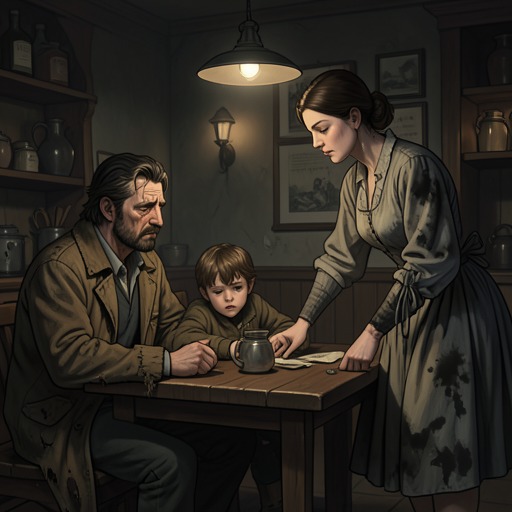
Katerina Ivanovna
Crime and PunishmentKaterina Ivanovna is the educated, proud wife of Semyon Zaharovitch Marmeladov and the mother and stepmother responsible for three young children in a household reduced to severe poverty. Her character is presented through two contrasting views: Marmeladov’s admiring, remorseful account of her past and the narrator’s immediate depiction of a sick, overburdened woman facing the consequences of his return. Together, these portrayals make her dignity neither an abstract virtue nor a simple trait; it persists amid deprivation, while pressure also finds expression in anger and harsh treatment of the children.
Identity and Background
Before marrying Marmeladov, Katerina was a widow with three children. Her first husband, an infantry officer, had married her for love after she ran away from her father’s house. Marmeladov says she remained devoted to that husband even though he took to cards, got into trouble, and beat her toward the end of their marriage. After his death, she was left with the children in a remote district, in poverty so severe that Marmeladov says he cannot describe it. Her relatives had rejected her, and he remembers her as excessively proud even then.
Katerina’s earlier education remains important to how she understands herself. Marmeladov recalls that she attended a high-class school for the daughters of noblemen, performed a shawl dance before the governor and other officials, and received a gold medal and a certificate of merit. The medal was eventually sold, but she kept the certificate in her trunk and showed it to the landlady. That act preserves a record of distinction in a life where most material signs of the past have disappeared. Marmeladov does not condemn her for recalling her former status; he understands memory as one of the few things she still possesses.
Life in Poverty and Illness
In the room shared by the family, poverty is visible in the disorder, the scattered children’s clothes, and the sparse furnishings. The family’s space is effectively a passage adjoining the other rooms in the flat. Katerina is described as tall and slim, with dark brown hair, but terribly emaciated; she has a feverish flush and broken breathing. The narrator also notes her coughing and the smoke that drifts in from the adjoining rooms. These details establish her illness and difficult surroundings without reducing her to them: she is pacing, pressing her hands to her chest, and absorbed in thought when Marmeladov and Rodion Romanovitch Raskolnikov arrive.
Marmeladov says that Katerina works from morning until night, scrubbing and cleaning and washing the children, habits rooted in her childhood training in cleanliness. The family lives in a cold room, and he reports that she has begun coughing blood and is vulnerable to consumption. His account connects her failing health to both their living conditions and the demands placed on her. He also admits that he sold her stockings and her mohair shawl for drink. The shawl had been given to her long before and belonged to her; the loss of these possessions makes his drinking a direct depletion of what little she has, not merely a private failing.
Pride, Anger, and Family Conflict
Katerina’s pride governs how she responds to humiliation. Though she scrubs floors and has only black bread to eat, Marmeladov says she will not accept disrespect. He links her reaction to Mr. Lebeziatnikov’s rudeness with her strong sense of personal dignity: after he beat her, she took to her bed more from wounded feelings than from the blows. This account comes from her husband, whose sympathy for her is bound up with his guilt, but it also corresponds to the narrator’s portrayal of a woman whose circumstances have not erased her insistence on being treated as a person of standing.
Her behavior toward the children complicates that portrait. Marmeladov acknowledges that when they cry, even from hunger, Katerina falls to beating them. In the later scene, the boy is crying in a corner while his older sister tries to comfort him, and the youngest child is asleep on the floor. The children’s distress is part of the immediate household crisis, not background decoration. The narrative places Katerina’s care and labor beside her harshness, showing a family under pressure without presenting deprivation as an excuse that cancels the harm within the home.
Marriage and the Household Crisis
Marmeladov describes himself as a disgrace beside Katerina, whom he considers a woman of education and noble feeling. He says that she sometimes shows him compassion, even though she pulls his hair, and that she has at times felt for him despite her anger. His account is deeply self-accusing: he has sold her belongings and recognizes that his conduct worsens the family’s suffering. At the same time, he describes drinking as a way of seeking sympathy and intensifying his own suffering. His explanation does not undo the consequences for Katerina, who must continue working while ill and caring for the children.
When Marmeladov returns with Raskolnikov, Katerina first notices the stranger and then sees her husband kneeling in the doorway. She searches him for money and finds none. Marmeladov reports that twelve silver roubles had been left in the chest; Katerina believes he has spent them drinking and pulls him into the room by the hair. He submits to the search and crawls along on his knees. The children react with fear and crying, while Katerina points to their hunger and confronts Raskolnikov, whom she assumes has been drinking with her husband. The scene turns Marmeladov’s earlier confession into a visible domestic emergency: his return has not restored anything to the household, and the missing money sharpens the family’s immediate need.
Katerina and Sofya Semyonovna
Marmeladov’s account also recalls an earlier moment between Katerina and her stepdaughter, Sofya Semyonovna Marmeladova. At six in the evening, Sofya put on her kerchief and cape and left. When she returned at about nine, she silently placed thirty roubles on the table without looking at Katerina. She then covered her head and face with the family’s green shawl and lay facing the wall, her shoulders and body shaking. Marmeladov says he watched without intervening.
Katerina later went quietly to Sofya’s bed, knelt, and kissed her feet through the evening; the two eventually fell asleep in each other’s arms. The contrast between the money placed on the table and the wordless tenderness that follows gives their relationship a form the surrounding arguments do not. Marmeladov’s account does not explain every feeling or circumstance behind the exchange, but it records both women’s actions: Sofya provides money without speaking, and Katerina answers with sustained affection. This episode prevents her anger and pride from being mistaken for an absence of attachment.
Narrative Role
Katerina is introduced at first through her husband’s speech, where her education, former honors, illness, and dignity are filtered through his remorse. When she appears directly, the focus shifts to her physical exhaustion, the children, the room, and the missing money. The difference matters: Marmeladov’s account invites sympathy for the woman he has wronged, while the scene also shows her anger and the fear it produces in the household. Neither presentation wholly replaces the other.
Her certificate, the sold shawl, the twelve missing roubles, and the thirty roubles Sofya places on the table each mark a different pressure on family life: remembered status, a possession lost to drink, money consumed, and money given in silence. Through Katerina, the narrative traces how poverty and illness constrain a person who continues to defend her dignity, while also showing that suffering can coexist with conduct that injures those closest to her. Her relationship with Sofya, especially their silent exchange and embrace, supplies a counterpoint to the public disorder of the household: affection persists, but it does not remove the material crisis surrounding them.